


The Science of Spinal Decompression: Biomechanical Restoration

Updated: Oct 11
Persistent back or neck pain can leave patients feeling that their choices are limited to medication, injections, or surgery. These treatments can have an important role, and surgery may be necessary for certain conditions. However, they are not the only options for every patient, and surgery is not automatically the best or only next step simply because an MRI shows a herniated or degenerative disc.
Medication may help manage symptoms, but symptom relief does not always address the factors contributing to a patient's pain or functional limitations. When symptoms persist, patients may benefit from a more comprehensive evaluation and a discussion of appropriate alternatives, including conservative, non-surgical care.
At Triangle Spinal Decompression in Cary, NC, computerized spinal decompression is one conservative option that may be considered for selected patients with certain disc-related conditions. Understanding its proposed biomechanical effects, potential benefits, and limitations helps patients make more informed decisions about their care.
When surgery is being considered, an appropriate conservative-care evaluation or second opinion may help clarify the available options—without delaying necessary medical or surgical treatment.
The Biomechanics of Spinal Decompression and Intradiscal Pressure
The intervertebral disc is a specialized structure that helps distribute loads and absorb forces placed on the spine. Its nucleus pulposus, annulus fibrosus, and endplates work together to accommodate compression and movement. Age-related changes, cumulative loading, injury, and disc degeneration can alter the disc's structure and mechanical behavior, sometimes contributing to disc bulging or herniation.
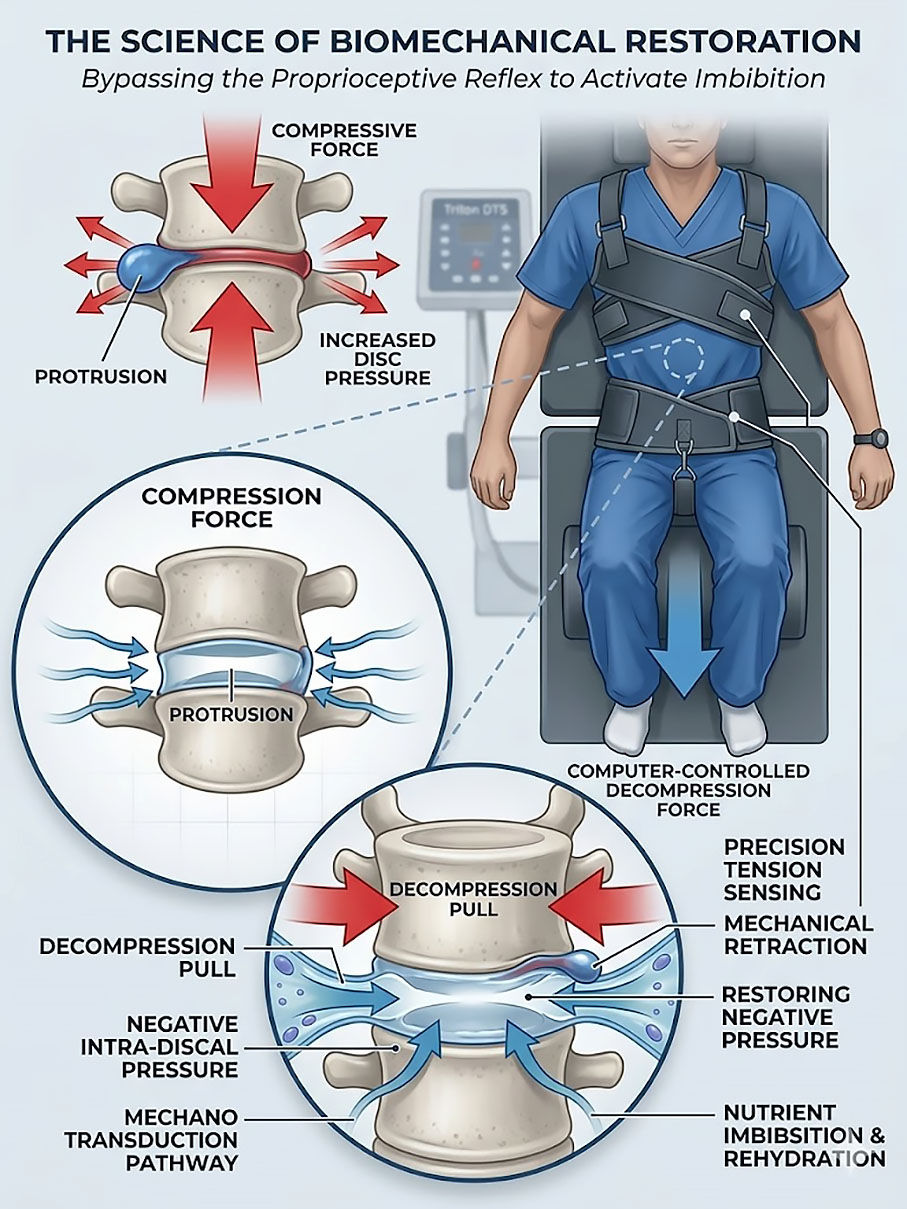
Non-surgical spinal decompression uses a computer-controlled pull pattern designed to apply carefully modulated forces to targeted spinal segments. Research has documented reductions in intradiscal pressure during certain spinal decompression procedures, including measurements of negative pressure. This proposed “vacuum effect” may influence disc mechanics, although its clinical significance and relationship to changes in herniated disc material require careful interpretation. See the published clinical research on non-surgical spinal decompression for further background.
The potential clinical significance of this pressure change remains an important area of investigation. Although negative intradiscal pressure provides a biomechanical rationale for decompression, it should not be assumed to reliably retract herniated disc material or restore damaged disc tissue in every patient.
Two proposed mechanisms are particularly relevant:
Changes in disc loading: Alternating periods of loading and unloading may alter mechanical stresses on the disc and surrounding structures. However, this should not be interpreted as proof that decompression physically retracts herniated material.
Fluid movement and nutrient exchange: Intervertebral discs have a limited direct blood supply and depend largely on diffusion and fluid movement for nutrient exchange and waste removal. Mechanical loading influences these processes, but it has not been established that spinal decompression reliably restores disc hydration or regenerates damaged disc tissue.
These mechanisms provide a scientific rationale for investigating spinal decompression. They do not, by themselves, establish how much benefit an individual patient will experience. Clinical outcomes depend on the patient's condition, appropriate treatment selection, and response to care.
Muscle Guarding and the Challenge of Spinal Traction
One challenge in spinal traction is the body's natural response to stretch and mechanical loading. Sensory receptors, including muscle spindles and Golgi tendon organs, provide the nervous system with information about muscle length, tension, and movement. Depending on the applied force and the individual's response, traction may trigger protective muscle activity or guarding that can affect treatment tolerance.
Computerized spinal decompression is designed to apply controlled, progressive traction using programmed pull patterns and adjustable forces. Rather than relying solely on a fixed pulling force, computerized systems allow treatment parameters to be tailored to the patient and adjusted according to comfort and tolerance.
This controlled approach is intended to help patients tolerate the applied traction while targeting the selected spinal segments. However, it should not be described as completely bypassing the proprioceptive reflex or guaranteeing that the paraspinal muscles remain relaxed. Individual responses vary, and treatment parameters should be adjusted according to clinical findings and patient tolerance.
The practical objective is to deliver a controlled mechanical stimulus that the patient can comfortably tolerate—not to overpower the body's protective responses.
Mechanotransduction: How Cells Respond to Mechanical Loading
The clinical rationale for spinal decompression extends beyond immediate symptom relief to the broader concept of biomechanical restoration. One biological process relevant to this discussion is mechanotransduction—the process by which cells sense mechanical forces and convert them into biochemical signals that influence cellular activity.
Within intervertebral discs, cells respond to their mechanical environment, and research has shown that loading conditions can influence cellular processes involving the extracellular matrix, including the production and maintenance of collagen and proteoglycans. These responses depend on factors such as the magnitude, duration, and frequency of loading, as well as the health of the disc tissue.
Spinal decompression applies controlled cycles of loading and unloading intended to modify mechanical stresses on the spine. It is biologically plausible that changes in mechanical loading may influence disc-cell activity. However, evidence that cells respond to mechanical stimuli does not establish that computerized decompression reliably stimulates meaningful disc regeneration or restores the structural integrity of a damaged disc in patients.
This distinction is central to understanding biomechanical restoration: the objective is to improve mechanical function and address contributing factors where possible, while recognizing that the extent of recovery depends on the underlying condition and the individual's response to care.
Establishing Clinical Candidacy
Not every patient with back or neck pain is a candidate for spinal decompression. Appropriate selection begins with a comprehensive clinical evaluation of the patient's history, symptoms, examination findings, and relevant diagnostic imaging.
Understanding MRI findings in the context of a patient's symptoms is particularly important; decoding your spinal MRI can help explain why imaging alone does not determine the appropriate course of care.
This evaluation may include:
Segmental Mobility: Assessing spinal movement and identifying areas of restricted or painful motion that may contribute to functional limitations.
Neurological Integrity: Evaluating sensation, muscle strength, reflexes, and other relevant neurological findings to identify possible nerve involvement and determine whether further investigation or referral is warranted.
Biomechanical Loading: Considering how posture, movement patterns, occupational demands, and daily activities may influence symptoms and mechanical stress on the spine.
Clinical Suitability: Reviewing the patient's diagnosis, symptom pattern, medical history, imaging findings when available, and any contraindications or warning signs that could make decompression inappropriate.
The goal is to determine whether spinal decompression is a reasonable option for the individual—not simply whether an MRI shows a disc bulge or herniation. Treatment decisions should reflect the complete clinical picture, with reassessment used to evaluate the patient's response and guide ongoing care.
To learn more about how these factors are assessed in practice, read our guide to what happens during a spinal decompression evaluation.
A Foundation for Physical Resilience
Understanding spinal health through biomechanics means looking beyond symptoms alone to consider how the spine responds to loading, movement, and the demands of daily life. This perspective informs the concept of biomechanical restoration: evaluating contributing mechanical factors and selecting appropriate strategies to improve function where possible.
Computerized spinal decompression is one conservative treatment option that may be appropriate for selected patients with certain disc-related conditions. Learn more about non-surgical spinal decompression at Triangle Spinal Decompression, including how treatment is individualized to the patient's clinical presentation and response to care.
At Triangle Spinal Decompression in Cary, NC, treatment decisions are guided by clinical evaluation, individual suitability, and reassessment of progress. The objective is to help appropriate patients improve function and manage their symptoms through an individualized, non-surgical approach, while recognizing when other forms of medical or surgical care may be necessary.



Comments