


Shockwave Therapy for Back Pain: Paired With Decompression

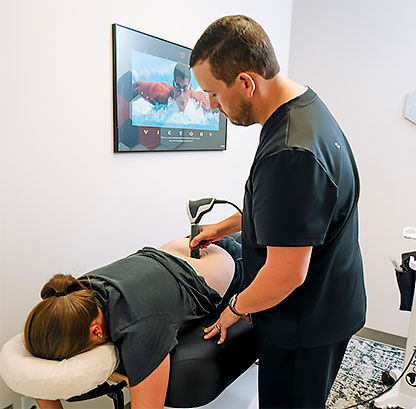
If you've been dealing with chronic back pain for months — or years — you've probably tried the basics: rest, stretching, maybe a round of physical therapy that helped for a while and then didn't. At some point, the question isn't "what else can I try," it's "why isn't the tissue healing the way it's supposed to?"
That's the question shockwave therapy for back pain is built to answer.
What Shockwave Therapy for Back Pain Actually Is
Extracorporeal shockwave therapy (ESWT) uses acoustic pressure waves — not electricity, not heat — delivered through the skin to targeted areas of chronic soft-tissue pain. The waves create controlled microtrauma in tissue that has stalled out in a chronic, low-grade inflammatory state. That sounds counterintuitive: why would you want to create more trauma in an area that already hurts?
The answer is that chronic pain tissue is often not actively healing at all. It's stuck. Blood flow is poor, cellular turnover has slowed, and the body has essentially stopped trying to repair the area. Shockwave therapy interrupts that stall. It triggers a fresh, localized healing response — new blood vessel formation, increased circulation, and reactivation of the body's own repair processes — in tissue that had otherwise plateaued.
This is different from acute injury care, where the goal is calming inflammation down. With chronic back pain, the goal is often the opposite: waking a repair process back up.
What Shockwave Treats
Shockwave therapy is most effective for chronic, localized soft-tissue conditions tied to the muscles, tendons, ligaments, and fascia surrounding the spine — not the disc itself.
Common applications we see include:
Chronic lower back muscle and fascial pain that hasn't responded to rest or stretching
Tendinopathies affecting the muscles that stabilize the spine
Trigger points and areas of persistent muscular tightness that keep recurring in the same location
Soft-tissue pain that lingers after a disc issue has otherwise improved
That last point matters. A lot of patients come to us because a disc problem brought them in the door, but months of guarding, compensating, and altered movement patterns have left the surrounding soft tissue in its own chronic state — separate from, but tangled up with, the original problem.
Why We Pair It With Spinal Decompression
Shockwave therapy and non-surgical spinal decompression are solving two different problems, and that's exactly why they work well together.
Decompression addresses the disc itself — gently creating negative pressure within the disc space to reduce bulging or herniated material, take pressure off compressed nerves, and improve the flow of fluid and nutrients into the disc so it can begin to heal.
Shockwave therapy addresses everything around the disc — the muscles, fascia, and connective tissue that have tightened, guarded, and gone into a chronic holding pattern while your body tried to protect the injured area. (When that soft-tissue guarding is the dominant issue on its own, myofascial release is often the more direct tool — shockwave tends to be the better fit when the tissue has become chronically stuck rather than simply tight.)
Treating one without the other often leaves a gap. Decompress the disc alone, and the surrounding muscles may still be locked into old compensation patterns that keep pulling you back toward pain. Treat the soft tissue alone, and you haven't addressed the disc problem that got the guarding started in the first place. Used together, decompression creates room and relief at the disc level while shockwave therapy helps the surrounding tissue actually let go and rebuild — so the improvement holds.
What a Session Feels Like
Shockwave therapy sessions are quick — typically 10 to 15 minutes — and don't require any downtime. We deliver treatment using the Chattanooga Shockwave system, the same clinical-grade equipment used for chronic soft-tissue adhesions and mechanical dysfunction.
Most patients describe the sensation as a rhythmic tapping or pulsing, with some tenderness over the treated area during the session itself. It's an in-office, non-invasive treatment with no needles, no incisions, and no sedation.
Because it works by triggering a biological repair process rather than providing immediate mechanical relief, results build over a series of sessions rather than appearing after just one. Most patients notice initial changes within two to three weeks and continued improvement as the healing response continues over the following weeks.
Who Tends to Benefit Most
Shockwave therapy tends to be the right fit for patients who:
Have had chronic back pain for more than a few months, rather than a recent acute injury
Have already tried general stretching or basic PT without lasting results
Have a specific, localized area of tightness or tenderness that keeps recurring
Are already in decompression care and have a persistent soft-tissue component that isn't resolving alongside the disc improvement
It's not typically the first tool we reach for with a fresh, acute injury — that's where more conventional inflammation management comes in first. It's most valuable once pain has become chronic and the tissue itself needs a reason to start healing again.
The Bigger Picture
Chronic back pain rarely has one single cause, which is exactly why it rarely responds to one single treatment. The disc, the surrounding muscles, and the fascia all adapt to each other over months of pain — and all of them usually need to be part of the solution.
If you've been through the standard first round of treatments and you're still dealing with a specific, stubborn area of tightness or pain that won't fully resolve, shockwave therapy paired with decompression may be the combination that finally gets the tissue moving in the right direction again.
Related reading:
If you're not sure whether shockwave therapy is right for your specific situation, the best next step is a consultation where we can evaluate your disc and your soft tissue together, rather than treating either one in isolation.


Comments