


TENS vs. Interferential Therapy: What’s the Difference and When Is Each Used?

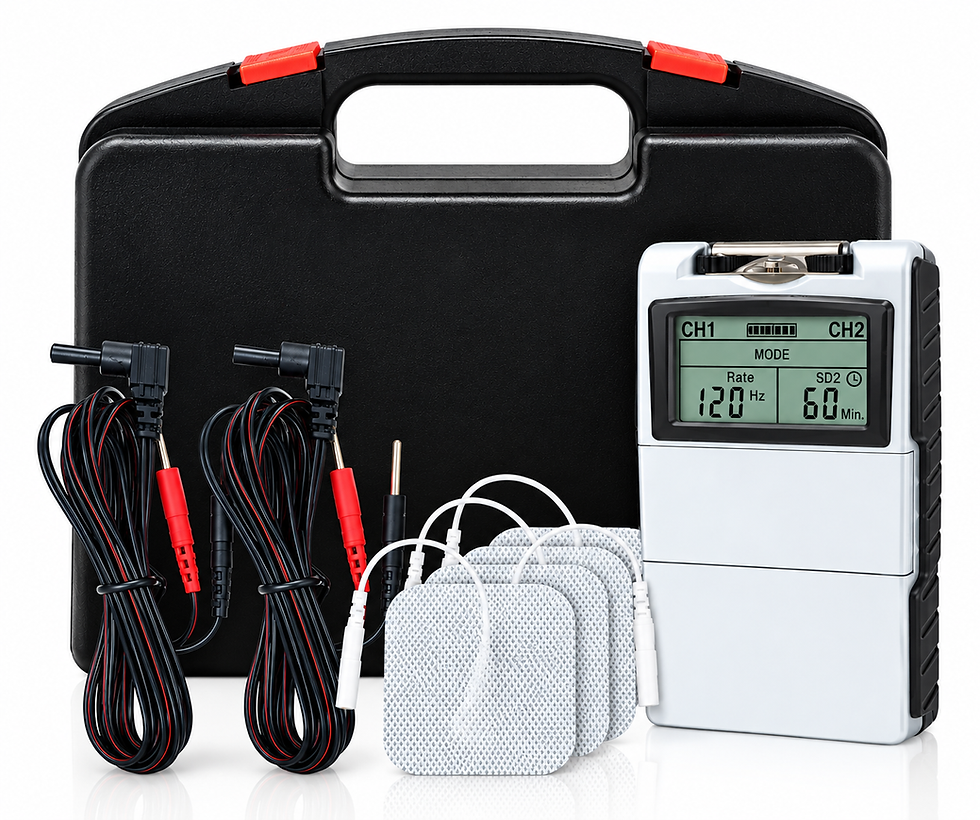
If you have searched for non-drug options for back pain, neck pain, muscle pain, or other musculoskeletal problems, you may have come across two similar-sounding treatments: TENS and interferential therapy.
Both use electrical stimulation through electrodes placed on the skin. Both may be used as part of a broader pain-management or rehabilitation plan. But they are not exactly the same — and the choice between them depends on the treatment goal, the location of symptoms, and whether treatment is being provided in the office or used at home.
At Triangle Spinal Decompression in Cary, NC, interferential therapy may be incorporated into a broader treatment plan when appropriate. In some situations, a clinician may also recommend a portable TENS unit for use between appointments.
So, what is the difference between TENS and interferential therapy, and when might each make sense?
What Is TENS?
TENS, or transcutaneous electrical nerve stimulation, uses small electrical impulses delivered through electrodes placed on the skin.
The stimulation is intended primarily to influence how pain signals are processed by the nervous system. TENS devices are generally portable, allowing some patients to use them at home according to instructions from their healthcare provider.
Because TENS can be used outside the clinic, it can have a different role from an in-office modality such as interferential therapy.
For example, a patient dealing with intermittent musculoskeletal pain may benefit from having a non-drug option available between visits, particularly when symptoms interfere with normal activities.
TENS is not appropriate for everyone, and the electrode placement, intensity, frequency, and duration should be determined based on the individual's situation.
What Is Interferential Therapy?
Interferential therapy (IFT or IFC) is another form of electrical stimulation. Instead of delivering the same type of stimulation used by a conventional TENS unit, interferential therapy uses two medium-frequency currents that interact to produce an interferential current in the treatment area.
The treatment is typically delivered in a clinical setting using multiple electrodes.
At Triangle Spinal Decompression, Interferential Therapy may be used as one component of a larger treatment plan rather than as a stand-alone solution.
The goal is generally to help manage symptoms while the underlying condition is being addressed through appropriate physical medicine and rehabilitation strategies.
TENS vs. Interferential Therapy: What's the Difference?
The easiest way to think about the difference is that both are electrical stimulation therapies, but they are delivered differently and may have different practical applications.
TENS | Interferential Therapy (IFC) | |
Primary use | Pain management | Pain management as part of clinical care |
Typical setting | Often portable/home use | Usually administered in a clinical setting |
Electrodes | Typically two or more electrodes | Commonly uses four electrodes |
Portability | Portable units are widely available | Generally requires clinical equipment |
Use between visits | Yes, when recommended | Generally no |
Treatment selection | Often useful when ongoing symptom management is needed | May be selected for an in-office treatment session |
Role in care | May provide symptom relief between treatments | May complement other therapies during a clinical visit |
The important point is that one isn't automatically better than the other.
Research comparing TENS and interferential current has found broadly similar effects on pain in several populations, although individual studies and more recent reviews have produced different results depending on the condition and treatment parameters. Evidence for both modalities is also highly dependent on the specific condition being treated.
Why Would the Doctor Recommend a TENS Unit?
One of the biggest practical advantages of TENS is that it can potentially be used outside the clinic.
Suppose a patient is receiving care for a painful musculoskeletal condition. Symptoms may not occur only during the appointment. They might become more noticeable after sitting at a desk, driving, exercising, sleeping, or performing certain daily activities.
In selected cases, a TENS unit can give the patient another tool to use when symptoms occur between appointments.
This does not mean the TENS unit is treating the underlying cause of the problem. Instead, it can be used as part of a broader strategy for symptom management while the patient works toward improved mobility, strength, function, and recovery.
That distinction is important.
If the source of pain involves a disc, joint, nerve, muscle, or another structure, simply reducing the sensation of pain does not necessarily correct the underlying problem. That's why electrical stimulation is generally most useful when it is incorporated into an appropriate overall treatment plan.
Can TENS Be an Alternative to Prescription Pain Medication?
For some patients, a TENS unit can provide a non-drug option for managing pain.
That can be particularly relevant when a patient wants additional ways to manage symptoms without relying exclusively on medication.
The CDC recommends maximizing appropriate nonpharmacologic and nonopioid approaches for subacute and chronic pain and notes that treatment should be individualized according to the condition and patient.
However, TENS should not be viewed as a universal replacement for prescription medication.
The evidence for TENS varies considerably depending on the condition. For example, a systematic review used to inform a World Health Organization guideline found only a marginal, short-term reduction in pain from TENS for chronic primary low back pain, with very low certainty of evidence.
That is why we view TENS as a tool, rather than a cure or a substitute for appropriate medical care.
For the right patient, however, having a non-drug option available between appointments can be useful.
When Might Interferential Therapy Be Used?
Interferential therapy may be considered when a clinician wants to incorporate electrical stimulation into an in-office treatment session.
For example, it may be used alongside other conservative therapies when a patient is experiencing pain or functional limitations associated with a musculoskeletal condition.
Research on interferential current has found evidence of short-term improvements in pain in some populations. A systematic review of chronic nonspecific low back pain found moderate-quality evidence that interferential current reduced pain and disability immediately after treatment compared with placebo, although those benefits were not maintained at intermediate follow-up.
That reinforces an important principle: electrical stimulation is generally best viewed as one component of care, not the entire treatment plan.
TENS or IFC: Which One Is Right for You?
There isn't one electrical stimulation treatment that is right for everyone.
The choice may depend on:
The location and nature of your symptoms
Whether treatment is needed primarily in the clinic or between appointments
Your response to previous treatments
Your overall treatment goals
Whether the treatment is being combined with exercise, manual therapy, spinal decompression, or another approach
Whether there are medical reasons that make electrical stimulation inappropriate
For someone who needs a modality during a clinical visit, interferential therapy may be considered.
For someone who needs an additional tool that can be used between visits, a TENS unit may be worth discussing with their healthcare provider.
In some cases, neither may be appropriate.
Electrical Stimulation Shouldn't Replace a Proper Evaluation
Pain is a symptom, not a diagnosis.
Back pain, neck pain, leg pain, and other musculoskeletal symptoms can have many different causes. A treatment that helps temporarily manage pain does not necessarily tell you why the pain developed in the first place.
That is particularly important when symptoms include radiating pain, numbness, tingling, weakness, or persistent symptoms that are not improving.
At Triangle Spinal Decompression, evaluation is used to determine what may be contributing to the patient's symptoms and whether non-surgical care is appropriate. Depending on the findings, treatment may involve different combinations of therapies rather than relying on one modality.
For patients with appropriate disc-related conditions, non-surgical spinal decompression may be considered as part of the treatment plan.
For other patients, the appropriate approach may involve exercise, manual therapy, interferential therapy, dry needling, myofascial techniques, or another conservative treatment.
What If Your Pain Is Coming From a Disc?
Electrical stimulation can help with symptom management, but it does not replace an evaluation of the spine when disc involvement is suspected.
Symptoms such as back pain with leg symptoms, neck pain extending into the arm, numbness, tingling, or symptoms that persist despite conservative care may warrant a more detailed evaluation.
Our recent guide on neck pain treatment in Cary, NC explains why identifying the potential source of neck pain is important before choosing a treatment approach.
Similarly, patients interested in decompression can learn more about what happens during a spinal decompression evaluation, including how symptoms, examination findings, and imaging may be considered when determining whether decompression is appropriate.
The Bottom Line: TENS and IFC Have Different Roles
TENS vs interferential therapy are related treatments, but they are not interchangeable in every situation.
TENS offers the practical advantage of portability and may give selected patients a way to manage symptoms between appointments.
Interferential therapy is generally delivered in a clinical setting and may be incorporated into an in-office treatment plan.
Neither treatment should be considered a cure-all. Evidence for electrical stimulation varies by condition, and the goal should be to use the modality appropriately rather than assuming that more treatment is always better.
At Triangle Spinal Decompression in Cary, electrical stimulation may be one piece of a larger conservative care strategy. The appropriate treatment depends on what is causing your symptoms, what your examination shows, and how you respond to care.
If you're experiencing persistent back, neck, or radiating pain and want to understand whether a non-surgical approach may be appropriate, a clinical evaluation can help determine what options make sense for your particular situation.
Triangle Spinal Decompression is located at 3750 NW Cary Pkwy, Suite 105 in Cary, NC, and provides non-surgical spine care as part of Swank Chiropractic Sports Medicine.


Comments