


Spinal Decompression Success Rates: What Research Shows

Updated: Oct 27
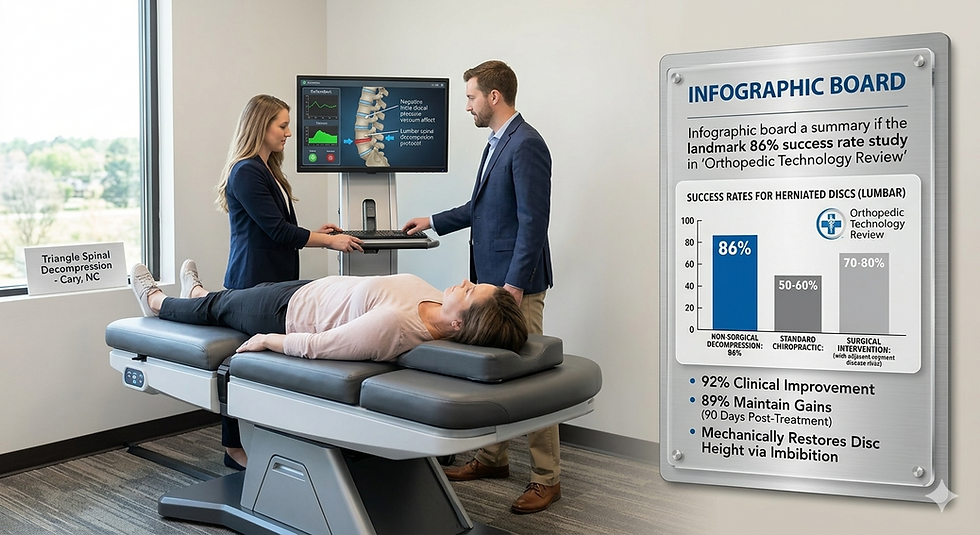
When considering advanced spinal care, patients in the Raleigh–Durham–Chapel Hill area deserve clear information about the evidence. Understanding spinal decompression success rates is essential for anyone weighing non-surgical care against other treatment options. Research has reported improvements in some patients with herniated discs and related symptoms, but results vary depending on the condition, patient characteristics, treatment protocol, and outcome measured.
At Triangle Spinal Decompression, Dr. Abbie Swank and Dr. Parker Neill evaluate each patient's symptoms, clinical findings, and available imaging to determine whether non-surgical spinal decompression may be an appropriate option.
Understanding Spinal Decompression Success Rates: The Clinical Evidence
In a landmark study published in Orthopedic Technology Review, researchers examined outcomes for 219 patients with herniated and degenerative disc disease. The data showed that 92% of patients had significant clinical improvement on physical examination, with 89% maintaining that improvement at a 90-day follow-up. Patient-reported outcomes were similarly strong: 86% reported immediate symptom resolution, with 84% remaining pain-free at 90 days.
These percentages represent different outcome measures and should not be interpreted as a single overall success rate. The 90-day follow-up provides information about outcomes over that period, but it does not establish that results will last indefinitely or predict how an individual patient will respond. When interpreting spinal decompression research, it is important to consider the study population, how improvement was defined, and the limitations of the evidence.
One proposed mechanism of spinal decompression involves changes in intradiscal pressure and fluid movement within the disc. The process of imbibition refers to fluid moving into disc tissue. However, the proposed mechanism does not guarantee disc rehydration, relief of nerve compression, or symptom resolution in every patient. Outcomes depend on the individual's condition and response to treatment.
Is Spinal Decompression an Affordable Alternative to Surgery?
Patients often want to understand the cost of non-surgical spinal decompression compared with other treatment options. Total costs vary according to the treatment plan, insurance coverage, deductibles, and individual circumstances. For details about treatment pricing at our clinic, see our guide to the real cost of spinal decompression.
A full cycle of spinal decompression is significantly more affordable than the cumulative costs of:
High surgical co-pays and hospital facility fees.
Weeks or months of lost wages during post-operative recovery.
The risk of Adjacent Segment Disease, which often leads to secondary surgeries.
For appropriate candidates, non-surgical spinal decompression may offer an option to consider before pursuing an invasive procedure. It is not appropriate for every condition and cannot guarantee that surgery will be avoided. Patients should discuss the potential benefits, risks, and alternatives with their treating healthcare professional.
Why Technical Precision Leads to Better Outcomes
A clinical evaluation helps determine whether spinal decompression may be appropriate and which areas may need attention. Treatment parameters can be adjusted according to the patient's presentation and response. Although computerized systems allow clinicians to customize treatment, selecting a particular disc level or distraction angle does not guarantee that pressure on a nerve root will be relieved or that symptoms will resolve. Learn more about L5-S1 and spinal fusion.
Take the Next Step Toward Restoration
If you have persistent back pain, radiating leg symptoms, or a diagnosed disc condition, a clinical evaluation can help determine whether non-surgical spinal decompression may be appropriate for you. Learn what to expect during a spinal decompression evaluation, including how symptoms, examination findings, and available imaging help inform candidacy and next steps.
Call Dr. Parker Neill or Dr. Abbie Swank today at 919-469-8897 or visit us at 3750 NW Cary Pkwy, Ste 105, Cary, NC 27513.


Comments